That metallic pinging or rattling sound coming from under your hood is not something to ignore. Engine knocking — also called spark knock, detonation, or pinging — is one of the most misunderstood sounds a car can make. Sometimes it is a cheap fix. Sometimes it is a warning sign of serious internal damage. Either way, understanding what causes engine knocking is the first step to protecting your engine and your wallet.
What Is Engine Knocking?
In a healthy gasoline engine, the air-fuel mixture inside each cylinder ignites at a precise moment — triggered by the spark plug — and burns in a controlled, smooth wave outward. Engine knocking happens when that combustion process goes wrong. Instead of one controlled burn, the fuel ignites in multiple spots simultaneously, or at the wrong time entirely. The resulting pressure waves collide inside the cylinder and create a sharp, metallic knock. That sound is the shockwave — and it is hammering your pistons, rod bearings, and cylinder walls every time it happens.
There are two distinct types of abnormal combustion that what causes engine knocking: detonation and pre-ignition. They are related but different, and they have different causes and consequences.
Cause 1: Low-Octane Fuel
Octane rating measures a fuel’s resistance to igniting under pressure before the spark plug fires. High-compression engines compress the air-fuel mixture more aggressively, generating more heat. If the fuel’s octane rating is not high enough to withstand that heat and pressure, it ignites on its own before the spark plug fires. That is detonation, and it is the most common cause of engine knocking.
If your car requires 91 or 93 octane and you fill it with 87, you are likely to hear knocking under load — especially when accelerating hard, climbing hills, or towing. Modern cars have knock sensors that detect this and retard ignition timing to compensate, but that comes at the cost of power and fuel efficiency.
Fix: Use the octane grade specified in your owner’s manual. If your car says premium required, that is an engineering requirement, not a suggestion.
Cause 2: Carbon Buildup in the Combustion Chamber
Over time, carbon deposits accumulate on the tops of pistons, on intake valves, and on combustion chamber walls. These deposits absorb heat and stay hot long after the engine has been running — creating glowing hot spots that ignite the air-fuel mixture before the spark plug fires. This is pre-ignition, and it is more damaging than detonation because it creates extreme pressure spikes at the wrong point in the piston’s stroke.
Carbon buildup is especially common in direct-injection engines (GDI), where fuel is injected directly into the cylinder rather than through the intake port. Without fuel washing over the intake valves, carbon accumulates faster. Many modern turbocharged engines from BMW, Audi, and Volkswagen are known for this issue.
Fix: Use top-tier gasoline with detergent additives. Run a fuel system cleaner every 15,000 to 20,000 miles. For severe buildup, a professional walnut blasting or chemical intake cleaning is the most effective solution.
Cause 3: Faulty or Worn Spark Plugs
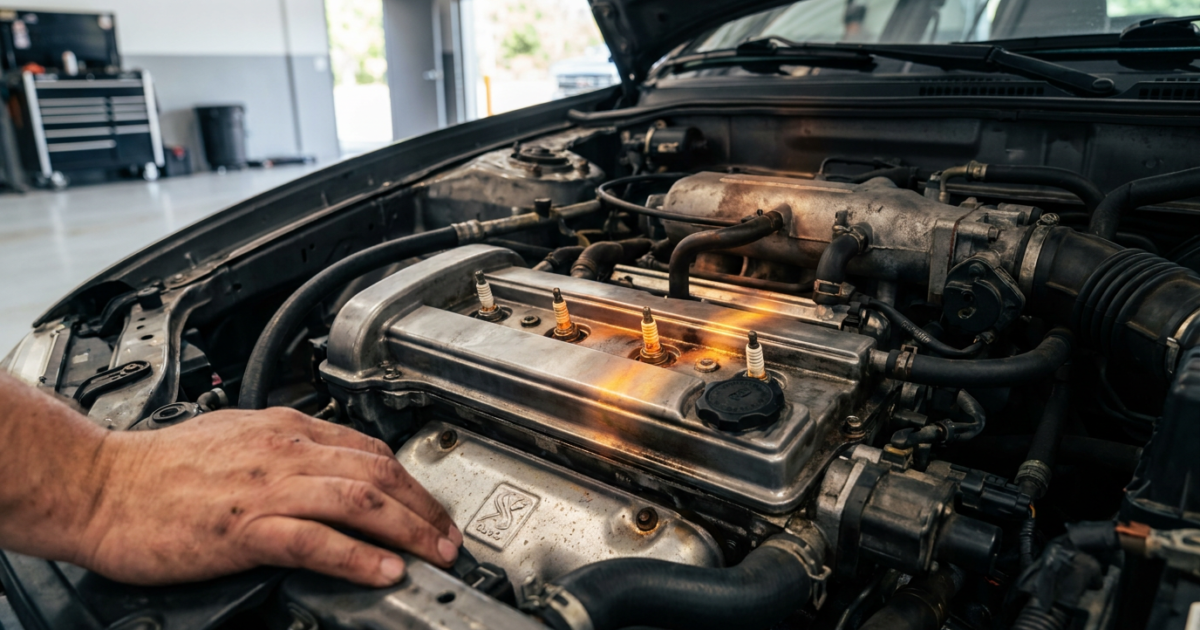
Spark plugs that are worn, fouled, or incorrectly gapped cause misfires and inconsistent ignition timing — both of which contribute to engine knocking. A plug that fires weakly or at the wrong moment allows unburned fuel to accumulate in the cylinder, which then ignites unevenly. A cracked spark plug tip is particularly dangerous — it can act as a pre-ignition source, glowing hot inside the cylinder and igniting the mixture before the plug fires.
Fix: Replace spark plugs at the manufacturer’s recommended interval — typically every 30,000 miles for copper plugs and every 60,000 to 100,000 miles for iridium or platinum plugs. Always use the correct plug specification for your engine.
Cause 4: Incorrect Ignition Timing
Ignition timing refers to exactly when the spark plug fires relative to the piston’s position. If the spark fires too early, the fuel ignites while the piston is still moving upward on the compression stroke — creating a pressure wave that fights against the piston’s motion. That collision produces a classic knock.
On modern vehicles, the ECU controls timing automatically, but a faulty crankshaft position sensor, camshaft position sensor, or knock sensor can cause the ECU to miscalculate timing and allow knock to occur.
Fix: Scan for fault codes first. A P0325 (knock sensor circuit malfunction) or crankshaft/camshaft sensor codes are common culprits.
Cause 5: Lean Air-Fuel Mixture
A lean mixture — too much air relative to fuel — burns hotter than a properly balanced mixture. That extra heat raises combustion chamber temperatures to the point where detonation becomes likely, even with the correct octane fuel. A lean condition can be caused by a dirty MAF sensor, a vacuum leak, clogged fuel injectors, a weak fuel pump, or a faulty oxygen sensor.
Fix: Scan for lean condition codes (P0171, P0174). Check for vacuum leaks. Test fuel pressure and injector function.
Cause 6: Overheating Engine
An engine running above its normal operating temperature creates the exact conditions that cause detonation — high heat, high pressure, and fuel that ignites before it should. If your temperature gauge is climbing and you are hearing knocking, those two problems are almost certainly connected.
Fix: Address the overheating cause immediately. Do not continue driving a knocking, overheating engine. For more on keeping your cooling system healthy, see our guide on how to flush a radiator at home.
Cause 7: Rod Knock — The Serious One
Not all engine knocking is combustion-related. A deep, rhythmic knocking that gets louder with engine speed — especially under load — may be rod knock. This is the sound of a connecting rod bearing that has worn out, allowing the rod to slap against the crankshaft journal with each rotation. Rod knock is caused by oil starvation, bearing wear from high mileage, or damage from a previous overheating event.
Fix: Rod knock requires engine disassembly and bearing replacement at minimum. If you hear a deep, rhythmic knock that changes with RPM, stop driving and have the car towed — continuing to drive will turn a bearing replacement into a full engine rebuild.
How to Tell the Difference Between Knock Types
- Knock only under acceleration or load: Likely detonation from low octane, lean mixture, or carbon buildup
- Knock at idle that disappears at speed: Could be a loose heat shield or exhaust manifold
- Deep rhythmic knock that follows engine RPM: Rod knock — serious mechanical failure
- Knock when cold that goes away when warm: Often piston slap from worn piston skirts
- Knock with check engine light: Scan for codes first — the ECU often knows exactly what is wrong
What Happens If You Ignore Engine Knocking?
Mild detonation that the knock sensor catches may cause no immediate damage, but persistent detonation will eventually erode piston tops, damage piston rings, and score cylinder walls. Pre-ignition is even more destructive — it can punch a hole through a piston in minutes under severe conditions. Rod knock left unaddressed will eventually cause a connecting rod to break free entirely, resulting in a hole in your engine block and total engine failure.
Preventing Engine Knock
- Always use the correct octane fuel for your vehicle
- Change your oil on schedule with the correct viscosity
- Replace spark plugs at the recommended interval
- Use top-tier gasoline with detergent additives to minimize carbon buildup
- Keep your cooling system in good shape — check coolant level monthly
- Do not ignore the check engine light — knock sensor codes are your early warning system
For authoritative guidance, Car and Driver’s engine knock explainer and Edmunds’ guide to engine knock are both excellent references. And if you are dealing with other warning signs, our post on how to check tire tread depth covers another easy DIY safety check.
Final Thoughts
Understanding what causes engine knocking puts you in a much better position to respond correctly — whether that means switching to premium fuel, replacing spark plugs, or getting the car to a shop before a bearing failure turns into an engine replacement. The sound itself is your engine telling you something is wrong. The sooner you listen, the cheaper the fix.
About The Author