Your tires are the only part of your car that actually touches the road. Everything else — the brakes, the suspension, the steering — works through them. So when your tire tread wears down, your safety margin shrinks fast. The good news is that learning how to check tire tread depth takes less than two minutes and costs nothing. You don’t need a mechanic, a lift, or any special equipment. Just a penny and this guide.
Most drivers don’t think about their tires until something goes wrong. But worn tread is one of the leading causes of blowouts, hydroplaning, and extended stopping distances. Knowing how to check tire tread depth regularly is one of the simplest things you can do to keep yourself and your passengers safe on the road.
Why Tire Tread Depth Matters
Tire tread isn’t just rubber — it’s a carefully engineered system of grooves, channels, and sipes designed to push water away from the contact patch between your tire and the road. When tread is deep, water has somewhere to go. When tread wears down, water has nowhere to escape, and your tire starts to ride on top of it instead of through it. That’s hydroplaning — and it can happen at speeds as low as 35 mph on a wet road.
Beyond wet weather, worn tread also affects:
- Braking distance: A tire at 2/32″ tread depth can take up to 100 feet longer to stop than a new tire at highway speeds
- Cornering grip: Less tread means less rubber biting into the road surface during turns
- Blowout risk: Thin tread exposes the tire’s internal structure to road hazards
- Fuel efficiency: Severely worn tires can slightly increase rolling resistance
The legal minimum tread depth in the United States is 2/32 of an inch. But safety experts — and most tire manufacturers — recommend replacing tires at 4/32″ or sooner, especially if you drive in rain or snow regularly.
Method 1: The Penny Test
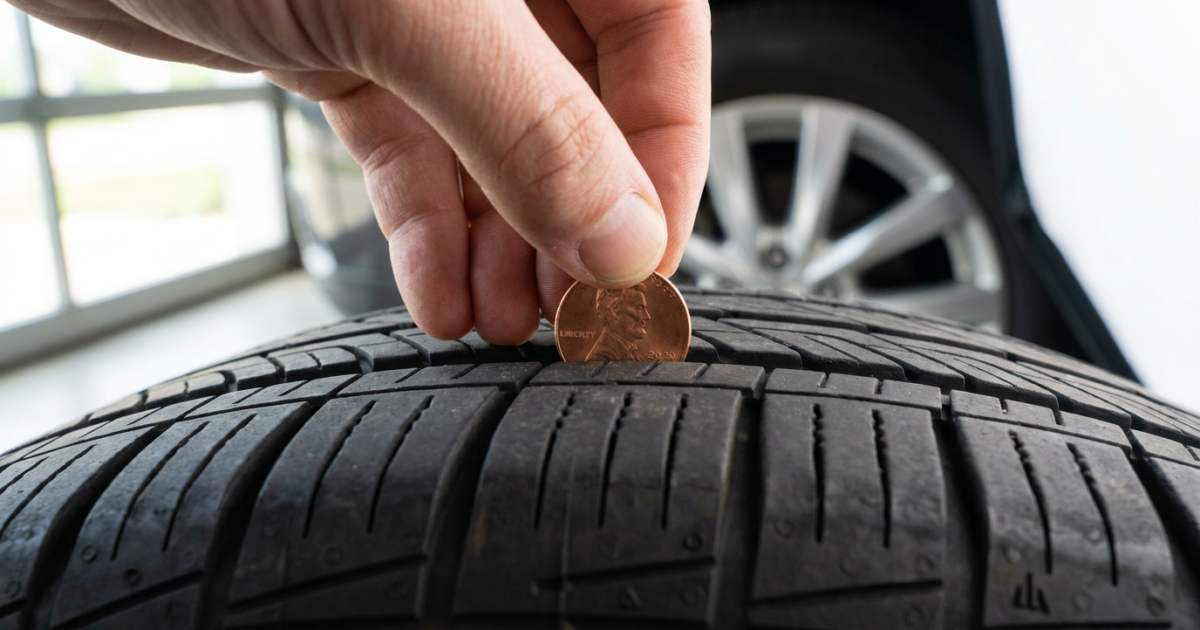
The penny test is the most well-known way to check tire tread depth at home, and it’s been around for decades. Here’s exactly how to do it:
- Take a standard US penny and hold it so Lincoln’s head faces down toward the tire
- Insert the penny into one of the main tread grooves — the deep channels that run around the circumference of the tire
- Look at how much of Lincoln’s head is visible above the tread
What the result means:
- If Lincoln’s entire head is visible — your tread is at or below 2/32″. Replace your tires immediately. They are legally and dangerously worn.
- If the tread covers part of Lincoln’s head — you have more than 2/32″ remaining, but keep monitoring closely.
The penny test is a pass/fail test. It tells you when your tires are dangerously worn, but it doesn’t give you much warning before that point. That’s why many experts now recommend the quarter test as a better early warning system.
Method 2: The Quarter Test (Better Early Warning)
The quarter test works the same way as the penny test, but gives you more lead time before your tires reach the danger zone.
- Take a US quarter and hold it with Washington’s head facing down
- Insert it into the same tread groove
- Check how much of Washington’s head is covered by the tread
What the result means:
- If the tread covers part of Washington’s head — you have at least 4/32″ remaining. You’re in the safe zone but should start budgeting for new tires.
- If Washington’s entire head is visible — you’re below 4/32″ and should replace your tires soon, especially before winter or rainy season.
The quarter test is the smarter choice for most drivers because it gives you time to shop for tires and plan the expense rather than being forced into an emergency replacement.
Method 3: Tread Wear Indicator Bars
Every modern tire manufactured since 1968 has built-in tread wear indicators — small raised rubber bars that sit at the bottom of the tread grooves at exactly 2/32″ height. You don’t need a coin or a gauge to use them.
Here’s how to find them:
- Look at the sidewall of your tire for a small triangle or the letters “TWI” (Tread Wear Indicator) molded into the rubber
- Follow that marker around to the tread surface
- Look into the groove — you’ll see a small raised bar of rubber running across the groove
If the tread surface is flush with those indicator bars, your tires are at 2/32″ and need to be replaced immediately. If the bars are still clearly below the tread surface, you have usable life remaining.
This method is the easiest of all — no tools, no coins, just a visual check. Make it part of your routine every time you fill up with gas.
Method 4: A Tread Depth Gauge (Most Accurate)
If you want a precise measurement rather than a pass/fail result, a tread depth gauge is the tool for the job. They’re available at any auto parts store for $5–$15 and give you an exact reading in 32nds of an inch.
How to use one:
- Find the most worn area of the tire — usually the center of the tread on front tires, or the outer edges on rear tires
- Press the probe straight down into the tread groove until the shoulders of the gauge sit flat on the tread blocks
- Read the measurement on the gauge
- Repeat in at least three spots across the width of the tire and in multiple locations around the circumference
Tread depth reference chart:
- 10/32″ – 11/32″: New tire (most passenger tires start here)
- 6/32″ – 9/32″: Good condition, plenty of life remaining
- 4/32″ – 5/32″: Start shopping for replacements, especially for wet/winter driving
- 3/32″: Replace soon — you’re approaching the danger zone
- 2/32″ or less: Replace immediately — legally worn out and unsafe
Where to Check — Don’t Just Test One Spot
Tires don’t wear evenly. Alignment issues, inflation problems, and driving habits all cause uneven wear patterns. A tire can have 6/32″ in the center and 2/32″ on the outer edge at the same time. If you only check one spot, you’ll miss it.
Always check tread depth in at least three locations across the width of each tire:
- Outer edge (driver’s side)
- Center of the tread
- Inner edge (passenger’s side)
Also check in multiple spots around the circumference — flat spots from hard braking or cupping from suspension issues will show up as localized wear that you’d miss with a single measurement.
If you notice significantly uneven wear across the width of the tire, that’s a sign of an alignment or inflation problem that needs to be addressed — not just a tire replacement issue.
How Often Should You Check Tire Tread Depth?
A quick visual check every month takes about 60 seconds per tire. A full measurement with a gauge or coin test should happen every 3 months or every 5,000 miles — whichever comes first. Also check before any long road trip and at the start of each season, especially before winter.
If your tires are getting close to the replacement threshold, check more frequently. Tread wear accelerates as the tire gets thinner — the last 2/32″ can disappear faster than you expect.
Signs Your Tires Need Replacing Beyond Tread Depth
Tread depth isn’t the only thing to look for. Replace your tires if you notice any of these regardless of remaining tread:
- Cracks or bulges in the sidewall — these indicate structural damage and blowout risk
- Visible cords or fabric showing through the rubber
- Persistent vibration that wasn’t there before
- Age over 6 years — rubber degrades even if tread looks fine. Check the DOT date code on the sidewall (last 4 digits = week and year of manufacture)
- Cupping or scalloping — a wavy, uneven wear pattern indicating suspension problems
Connecting Tire Health to Overall Car Maintenance
Tire tread checks work best as part of a broader maintenance routine. If you’re already checking your tires, it’s a good time to also check your tire pressure — underinflated tires wear faster on the outer edges, while overinflated tires wear faster in the center. Both patterns will show up when you check tire tread depth across the full width of the tire.
For more on keeping your car running well without expensive shop visits, check out our guide on low maintenance used cars for daily use — some vehicles are simply easier and cheaper to keep in good shape. And if you’ve been noticing other warning signs from your car, our post on signs your car battery is dying covers another easy DIY check you can do at home.
For the most up-to-date tire safety standards and replacement guidelines, NHTSA’s tire safety resource and Bridgestone’s tread depth guide are both excellent references.
Final Thoughts
Knowing how to check tire tread depth is one of the most practical safety skills a driver can have. It takes two minutes, costs nothing, and can prevent a blowout, a hydroplaning accident, or a failed inspection. Use the penny test for a quick pass/fail check, the quarter test for early warning, and a tread depth gauge when you want exact numbers. Check all four tires, check multiple spots on each one, and make it a habit every month.
Your tires are doing a lot of work every time you drive. Give them a quick look — they’ll tell you everything you need to know.
About The Author