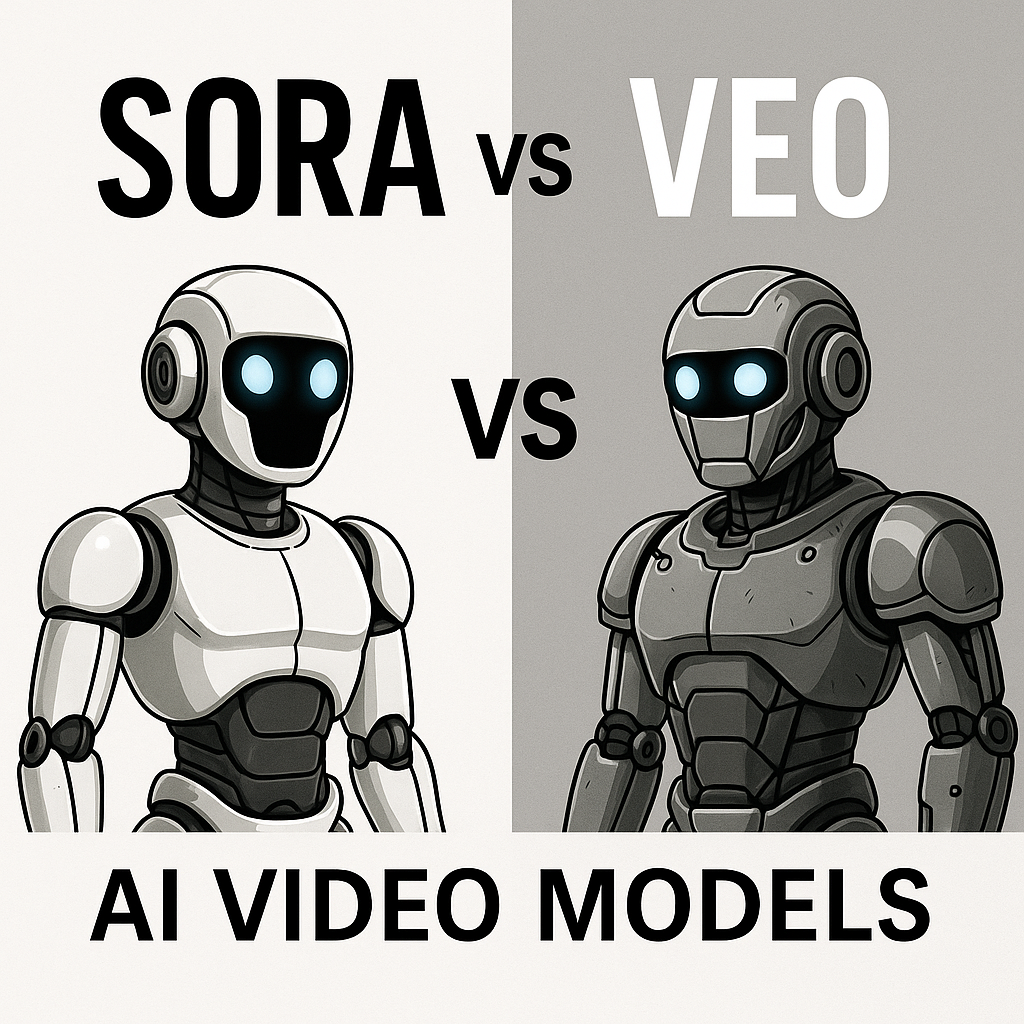
Futuristic representation of Sora and Veo, two leading AI models shaping the future of video generation.
AI video generation has moved beyond short clips and visual experiments. Today, two names dominate serious discussion in the field: Sora or Veo. Developed by OpenAI and Google DeepMind, these models represent a major shift toward cinematic, long-form, text-to-video creation.
As interest grows, so do the questions. Users want to know which model is better, whether Sora is free, how access works, and what the future holds for each platform. This guide breaks down Sora, Sora 2, Veo 3, and the broader AI video landscape in clear, practical terms.
What Are Sora and Veo?
Sora is an advanced generative AI video model created by OpenAI. It is designed to generate realistic, coherent videos from written prompts, maintaining consistent characters, environments, and physical motion across scenes.
Veo is Google’s answer to high-end AI video generation. Developed by Google DeepMind, Veo focuses on cinematic realism, camera movement, and high-resolution visuals, positioning itself as a direct competitor to Sora.
Both tools aim to replace complex production pipelines with AI-driven video creation, but they approach the problem in different ways.
Which Is Better Than Veo 3?
At the moment, very few AI video models are clearly better than Veo 3 overall. However, some outperform it in specific areas.
Veo 3 excels at:
-
Visual clarity and cinematic lighting
Search more topics
Explore related answers and trending queries in seconds.
-
Smooth camera transitions
-
High-quality short video output
Where Veo 3 struggles:
-
Maintaining narrative continuity over long scenes
-
Complex physical interactions
-
Public accessibility and user control
In side-by-side comparisons, Sora 2 often outperforms Veo 3 in scene consistency, physics modeling, and long-form storytelling. While Veo produces impressive visuals, Sora tends to generate videos that feel more grounded and logically coherent.
Sora 2 vs Veo 3: Which Is Better?
For most advanced use cases, Sora 2 currently holds the advantage.
Sora 2 demonstrates:
-
Better understanding of real-world physics
-
More stable object interaction
-
Longer scene memory
-
Fewer visual contradictions frame-to-frame
Veo 3 remains strong for:
-
Short cinematic clips
-
Visual polish
-
Controlled studio-style scenes
If your priority is storytelling, realism, and temporal consistency, Sora 2 is the stronger choice. If your focus is short, visually striking output, Veo 3 remains competitive.
Is Anything Better Than Sora?
As of now, no publicly known AI video system surpasses Sora across all categories.
Some platforms exceed Sora in narrow areas such as stylized animation or looping backgrounds. However, when progress is measured across:
-
Video length
-
Motion accuracy
-
Scene coherence
-
Prompt understanding
Sora remains the reference point. This is why new AI video models are often described in relation to Sora rather than independently.
Will There Be a Sora 3?
Sora 3 has not been officially announced, but continued development appears inevitable.
Based on OpenAI’s development patterns, future versions of Sora are expected to include:
-
Longer video duration
-
Higher resolution output
-
More precise facial and human motion
-
Increased creator controls
-
Improved object permanence
As compute capacity and training data scale, Sora is likely to remain central to OpenAI’s generative video roadmap.
Is Sora a Kid?
No. Sora is not a person, character, or digital being.
This misunderstanding often comes from the name itself or misinformation on social media. Sora is simply the name of an AI model. It has no age, personality, or consciousness and should not be confused with fictional characters or virtual avatars.
How Do I Get Sora Code?
There is no public Sora source code available for download or private use.
Sora is:
-
Not open-source
-
Not offered as a downloadable model
-
Not available as a public API
Access is currently limited to:
-
Research environments
-
Enterprise-level partnerships
-
Controlled testing by OpenAI
Any website claiming to sell “Sora code” is not legitimate.
Is Sora Free?
Sora is not free to the public at this time.
There is:
-
No free consumer access
-
No standalone Sora application
-
No public web interface
When Sora becomes more widely available, it is expected to follow a tiered or usage-based pricing model, similar to other OpenAI products, to manage compute demand responsibly.
Is Sora 2 Available on Android?
No. Sora 2 is not available on Android, iOS, or any other consumer platform.
Sora operates entirely in the cloud and requires high-performance GPU infrastructure. If access expands in the future, it will most likely be through web-based tools rather than mobile apps.
How Do I Join Sora?
Currently, joining Sora requires invitation or formal access approval from OpenAI.
Potential future access paths include:
-
Research partnerships
-
Developer programs
-
Enterprise-scale integrations
There is no public signup page or guaranteed timeline. Users interested in Sora should monitor official OpenAI channels for updates.
Sora or Veo: Which One Should You Watch Closely?
Both models matter, but Sora is shaping the benchmark for what AI video should achieve.
Choose Sora if you care about:
-
Realism and physics
-
Narrative continuity
-
Long-form video generation
-
Future-focused AI development
Choose Veo if you prioritize:
-
Cinematic visuals
-
Short-form content
-
Integration with Google’s AI ecosystem
In professional and research circles, Sora is widely viewed as the more advanced system, while Veo remains an important competitor pushing visual quality forward.
Why Sora and Veo Matter for the Future
AI video platforms like Sora and Veo are redefining how content is produced. Their impact will extend into:
-
Film and television
-
Advertising and marketing
-
Education and simulations
-
Game development
-
Virtual worlds
Understanding which model leads today provides a strategic advantage as access expands and tools mature.
About The Author

Search Anything
Search any topic — insurance, loans, travel, technology, health, and more.