
Common Financial Mistakes and How to Avoid Them
Most people make at least a few money mistakes along the way — and that is completely normal. What matters is recognizing them early and knowing how to course-correct. Understanding the most common financial mistakes and how to avoid them can save you years of stress, debt, and missed opportunities.
This guide covers the financial errors that trip up beginners and experienced earners alike, along with clear, practical steps to avoid each one. No judgment — just honest, useful information to help you make better decisions with your money.

Why People Make Financial Mistakes
Financial mistakes rarely happen because people are careless or irresponsible. They happen because most people are never taught how money actually works. Without a clear framework for budgeting, saving, and managing debt, it is easy to fall into patterns that feel normal but quietly undermine your financial health.
The good news is that awareness is the first step to change. Once you can name a financial mistake, you can take steps to avoid it — or fix it if it has already happened. Here are the most common ones to watch for.
Mistake 1: Spending More Than You Earn
This is the most fundamental financial mistake, and it is more common than most people realize. When your expenses consistently exceed your income, you accumulate debt — and debt with interest grows faster than most people expect.
How to avoid it: Track your income and expenses for one full month. Use a budget to ensure your spending stays within your take-home pay. If you are regularly overspending, identify which categories are the problem and set firm limits. Even small reductions in variable spending — dining out, subscriptions, impulse purchases — can quickly bring your budget back into balance.
Mistake 2: Having No Emergency Fund
Without an emergency fund, any unexpected expense — a car repair, a medical bill, a job loss — forces you to use a credit card or take on debt. This turns a manageable setback into a financial crisis that can take months or years to recover from.
How to avoid it: Start building an emergency fund immediately, even if you can only save $25 or $50 a month. Set a goal of $1,000 first, then work toward three to six months of essential living expenses. Keep this money in a separate savings account that is accessible but not connected to your everyday spending.
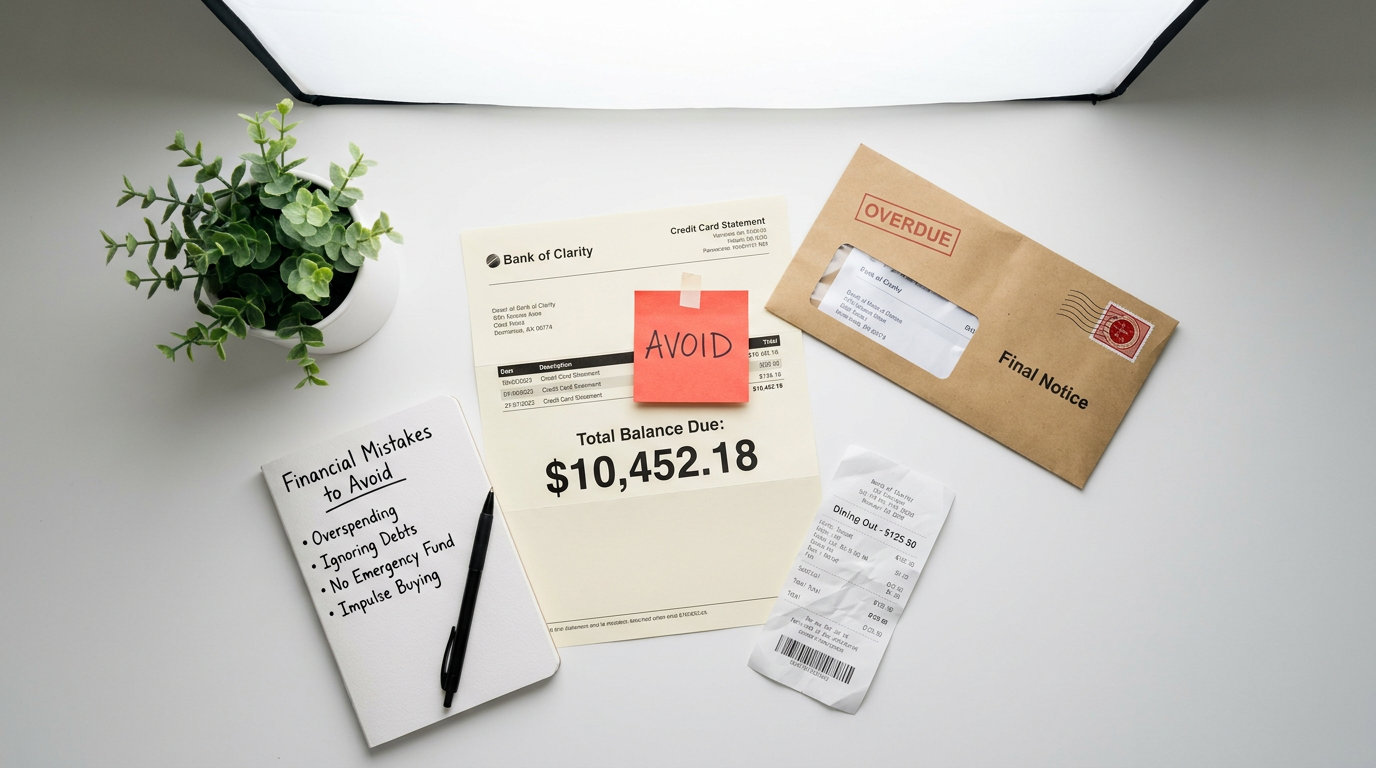
Mistake 3: Carrying High-Interest Credit Card Debt
Credit cards are useful tools when used correctly — but carrying a balance from month to month is one of the most expensive financial habits you can have. Credit card interest rates often range from 18% to 29% annually. A $2,000 balance at 22% interest costs you hundreds of dollars per year just in interest charges.
How to avoid it: Pay your credit card balance in full every month. If you already carry a balance, stop adding new charges and focus on paying it down aggressively using the avalanche method (highest interest first) or the snowball method (smallest balance first). Once paid off, treat your credit card like a debit card — only charge what you can pay in full at the end of the month.
Mistake 4: Not Having a Budget
Many people manage money by feel — spending when they have it and cutting back when they do not. This reactive approach makes it nearly impossible to save consistently, pay down debt strategically, or work toward financial goals.
How to avoid it: Create a simple monthly budget that accounts for all income and expenses. You do not need a complicated spreadsheet — even a basic list of income, fixed expenses, variable expenses, and savings is enough to give your money direction. Review it at the start of each month and adjust as needed.
Mistake 5: Waiting Too Long to Start Saving and Investing
One of the most costly financial mistakes is delaying savings and investment. Time is the most powerful factor in building wealth — the earlier you start, the more your money compounds. Waiting even five or ten years to begin investing can cost you tens of thousands of dollars in potential growth.
How to avoid it: Start saving and investing as early as possible, even with small amounts. Contributing $50 a month to a retirement account in your twenties is worth far more than contributing $200 a month starting in your forties. If your employer offers a 401(k) match, contribute at least enough to get the full match — that is free money you should never leave on the table.
Mistake 6: Making Only Minimum Payments on Debt
Paying only the minimum on a credit card or loan keeps you in debt for years and costs a significant amount in interest. On a $5,000 credit card balance at 20% interest, making only minimum payments could take over 15 years to pay off and cost more than $5,000 in interest alone.
How to avoid it: Always pay more than the minimum when possible. Even an extra $25 or $50 per month accelerates payoff significantly. Use a debt payoff calculator to see exactly how much time and money you save by paying more each month — the numbers are often motivating.
Mistake 7: Ignoring Your Credit Score
Your credit score affects your ability to rent an apartment, get a car loan, qualify for a mortgage, and even land certain jobs. Many people do not check their credit score until they need it — and by then, it may be too late to fix problems quickly.
How to avoid it: Check your credit score regularly using a free service. Review your credit report annually for errors — mistakes on credit reports are more common than most people realize and can drag down your score unfairly. Build good credit habits: pay bills on time, keep credit card utilization below 30%, and avoid opening too many new accounts at once.

Mistake 8: Lifestyle Inflation
Lifestyle inflation happens when your spending increases every time your income increases. A raise leads to a nicer apartment, a newer car, more dining out — and suddenly you are earning more but saving no more than before. This pattern keeps people financially stuck regardless of how much they earn.
How to avoid it: When your income increases, direct at least half of the increase toward savings, investments, or debt repayment before adjusting your lifestyle. It is fine to enjoy some of a raise — but letting all of it disappear into higher spending is a trap that is easy to fall into and hard to escape.
Mistake 9: Not Having Insurance
Skipping insurance to save money is a gamble that can backfire catastrophically. A single medical emergency, car accident, or house fire without adequate insurance can wipe out years of savings and leave you in serious debt.
How to avoid it: Make sure you have the essential coverage: health insurance, auto insurance, and renters or homeowners insurance at minimum. If you have dependents, life insurance is also important. Insurance is not an expense — it is protection for your entire financial plan.
Mistake 10: Making Financial Decisions Based on Emotion
Impulse purchases, panic selling investments during a market downturn, or taking on debt to keep up with others are all examples of emotional financial decisions. These choices often feel right in the moment but cause regret and financial damage later.
How to avoid it: Build a 24-hour rule for non-essential purchases over a set amount — if you still want it the next day, it is probably not an impulse. For investments, stick to your long-term plan and avoid reacting to short-term market movements. Make financial decisions based on your goals and your budget, not on feelings or social pressure.
For more on building strong financial habits, see our guides on How Personal Finance Works for Beginners and Basic Money Management Tips Everyone Should Know. The Consumer Financial Protection Bureau also offers free tools to help you check your credit, manage debt, and build better financial habits.
Conclusion
Understanding the most common financial mistakes and how to avoid them is one of the most valuable things you can do for your financial future. Most of these mistakes are not the result of bad intentions — they are the result of not knowing better. Now you do.
Pick one mistake from this list that resonates with your current situation and take one concrete step to address it this week. Small, consistent improvements compound over time — just like money does when you manage it well.
About The Author